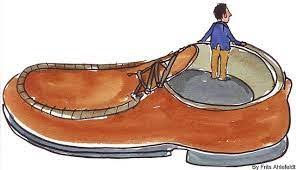
The best lesson I’ve learned about love is that the greatest gift I can give another person is to stop whatever I’m doing, really listen to what the other person is saying, and then make the added effort to see the world through that person’s eyes. That is easier said than done, especially if the other person, whether a lover, a relative, or a friend, is unhappy about something happening in their life. It’s even harder when that unhappiness stems, in their perception, from something I have done or not done.
My tendency is to get defensive, which is counterproductive in all respects. When defensive, I stop listening and start talking instead. When defensive, I have eliminated the possibility of putting myself in their shoes and seeing the world from their perspective. My other tendency is to skip over the emotions the person is expressing and go straight to a solution. This also brings a negative result because if they are self-aware, the other person will say, “I didn’t come here for you to fix the problem. I just need you to understand how I’m feeling and validate that feeling this way is reasonable.” I understand that reaction because I feel the same way when I share something vulnerable, and the other person skips over my emotions and goes to ways to change whatever I just complained about. In this case, complaining – from others and within ourselves – is key to getting in touch with one’s real feelings about a situation.
Once a thought surfaces as frustration or anger, it’s important to assess that thought and feeling. Is this truly about the other person to whom the negative emotion is aimed, or is it more about me and the baggage I’m bringing to the situation? For example, just because I get irritated at someone because of something they have said or how they have acted doesn’t automatically mean they are at fault. The truth is that I might be tired or hungry or worried about something else, and it’s easier to get annoyed at that other person than to stop and assess my emotional and physical states long enough to take responsibility for my reaction. Any good Buddhist would point out that others are not responsible for our reactions; we are. And in Rational Emotive Therapy, a therapist will agree with the Buddhist. That therapist might say, “It’s not what’s happening; it’s what you’re telling yourself about what’s happening.”
Some people think this is splitting hairs. Some situations are horrendous in reality, and no amount of minimizing of the situation will make them less horrible. For example, Jews being murdered in concentration camps during World War II was a truly horrific situation, and there’s no doubt about that. However, it could be argued that many Jewish individuals in those camps made the conscious choice to remain kind and give to their fellow prisoners even in the midst of terror. How was that possible, given the gravity of that circumstance? Victor Frankl, one of those prisoners who, post-war, wrote Man’s Search for Meaning, said, “Everything can be taken from a man but one thing: the last of the human freedoms, to choose one’s attitude in any given set of circumstances, to choose one’s own way.” That choice is the ultimate freedom. Even when faced with the most heartbreaking of circumstances, losing a loved one or child to the gas chambers, Frankl believed that he and his fellow prisoners could resist the urge to sink into hopelessness and look instead at how these circumstances offered the chance to experience love, “the ultimate and the highest goal to which man can aspire … The salvation of man is through love and in love.”
We have returned to the question of love and what I have learned over these years. I’d say that a true act of love is to listen with an open heart, a firmly closed mouth, and the willingness to imagine what life looks like from the perspective of the person sharing something deep and vulnerable. Sometimes a nod will suffice or “I hear you,” or “I get it.” That is what all of us really want, isn’t it? To have another human being “get” what we’ve said so we can feel seen and understood? That, to me, is real love.