I’ve been thinking lately about tricksters in literature since I’ve been working on a new novel. As I sketch characters and test their motives, the trickster keeps slipping onto the page. According to Christopher Vogler’s book The Writer’s Journey, a trickster “embodies the energies of mischief and desire for change.” That desire for change is what fascinates me most. The trickster unsettles things. He pokes at what is fixed. He forces movement where there might otherwise be stagnation.
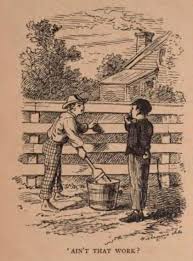
Tom Sawyer is a trickster we all know. Who else could get others to trade him toys and food for the chance to whitewash his fence, the chore he was supposed to do by himself? Br’er Rabbit is another example, pleading, “Please, please, Br’er Fox, whatever you do, please don’t throw me in that briar patch!”—which is exactly where he wants to go so he can escape.
I began thinking about examples of tricksters in my own life. Of course, we have all been tricksters as kids, saying to our parents on the day of a big test we’re not ready for, “I just can’t go to school today. I feel so sick.” Smart parents require bona fide symptoms such as a temperature over 99 degrees before they’ll allow little tricksters to stay home. Not so smart tricksters can be found out playing basketball a few hours after that major illness, or eating popcorn while watching a movie after claiming they have “the worst sore throat ever.”
My brothers were fairly well-accomplished tricksters growing up. My brother John would claim he was going to spend the night with his friend Greg, then drive the sixty miles to Dallas for the evening. He was all of sixteen. My brother Sam would say he was going to bed early, pretend he was asleep, then sneak out in the middle of the night. I did that, too, on more than a few occasions—pushing my little VW to the end of the block before starting it, then going “riding around” with a girlfriend for an hour or so. I hadn’t counted on the police in my small town spotting me in the middle of the night and reporting my escapades to my dad the next morning at the Gem Café. Luckily, we were only cruising the main drag. Still, knowing my father knew took most of the fun out of it.
In my current novel, the main character’s best friend, Jimmy—a gay seventeen-year-old—serves as her truth-teller. He challenges Hannah to look life squarely in the face and, when necessary, to bend a rule or two. He brings lightness to an otherwise intense situation, and while he nudges her forward, he never abandons her when the going gets tough.
I like Jimmy. He carries just enough mischief to keep things interesting, yet everything he does is grounded in fierce loyalty and Hannah’s best interest. In many ways, he embodies the classic trickster: irreverent, honest, catalytic—and deeply devoted.
Tricksters run the gamut from playful to dangerous. In literature, they are not always harmless; sometimes they expose hypocrisy, reveal hidden truths, or catalyze necessary upheaval. But often they add lightness, comic relief, that spark of “I wish I’d thought of that.” They keep the hero honest. They keep the plot from growing stale. They remind us that rules are human inventions—and sometimes meant to be tested.
We all need a bit of the trickster in ourselves and in our lives. After all, a little mischief never hurt anybody. And sometimes, it’s the trickster who nudges the story—and the soul—toward change.

 20 Minutes a Day